THE HOPE KILL SWITCH
Is There a Looming Behavioral Health Crisis Fueled by AI?
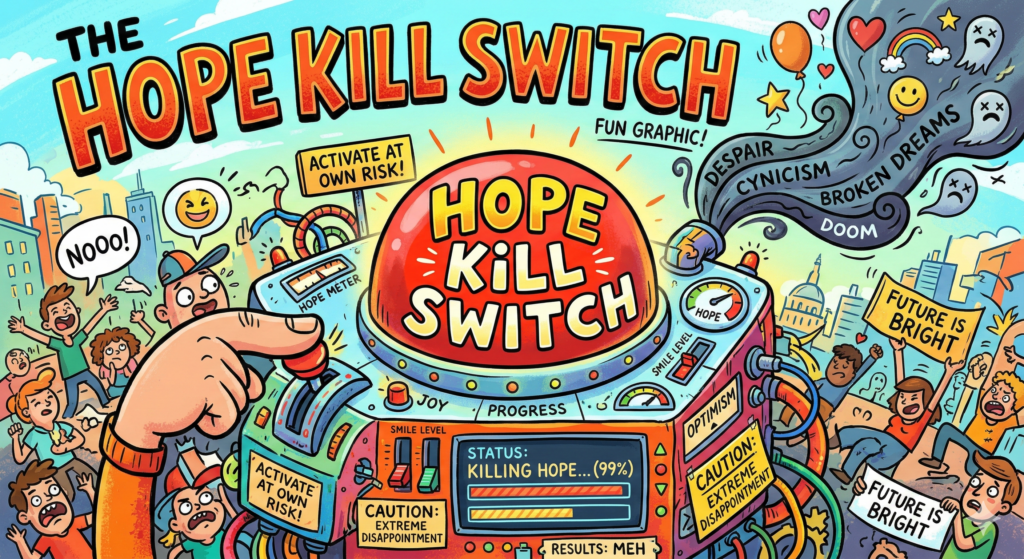
A (fictional) new AI-assisted neurotechnology system enables targeted deactivation of the neural substrates associated with anticipatory desire and goal-directed longing. In other words, AI can kill all your hopes with the click of a button.
It’s called The Hope Kill Switch, but it’s not quite as ominous as it sounds. Think of it as engineered peace—a soft quieting of the mind’s forward-leaning impulses. The benefits: no disappointment, no restless reaching, no ache for what forever hovers just out of reach.
Sure, you could argue that Buddhists have been prototyping their own version of a Kill Switch for centuries, refining it through meditation. After all, in that worldview, suffering springs from desire. But the Kill Switch offers a shortcut: it eliminates the source altogether. Activate it, and longing falls silent. Craving dissolves. The mind stops reaching for brighter tomorrows or imagining itself into better versions of who it is. This is true freedom and enlightenment, right?
But what the purveyors of the Kill Switch fail to see is exactly what Buddhism emphasizes: the aim is not to extinguish desire, but to transform our relationship to it. Strip away the gentle pull of aspiration—our capacity to imagine future possibilities—and the will itself goes slack. With longing deactivated, the inner climate that nurtures compassion, growth, and awakening simply thins out and disappears. The switch doesn’t liberate a person from suffering; it liberates them from becoming.
Now at first, the lack of hope feels like a kind of freedom — a silence where restlessness used to live. But as hours pass, something goes missing. The world remains visible, yet strangely colorless. Pleasure still exists, but it feels distant and unappealing. Sadness visits, but it has no depth. Without the subtle pressure of “what could be,” emotion loses its coordinates. The person still sees the world, but cannot want it. The pulse of the possible — that which early 20th Century German philosopher Ernst Bloch called das Noch-Nicht-Seiende (the Not-Yet-Being) — has gone eerily silent.
Bloch, whose work centers on the structural role of hope in consciousness, would say this person has lost their “wish-landscape”—the internal framework that organizes longing, projection, and anticipation. For Bloch, wishing is not passive but a mechanism that orients the mind toward unrealized possibilities. Kill it, and the individual’s orienting system collapses. Without a functional sense of the future, sustained well-being is impossible, because happiness depends on aligning anticipation with fulfillment. Even dissatisfaction requires a horizon to push against; without one, experience flattens into mere biological persistence rather than a psychologically integrated life.
Nor can there be real sadness either, because sadness—properly understood—is the tender ache of what has not yet come to pass, the painful but meaningful tension between aspiration and reality. Bloch insists that hope is never just optimism; it is the disciplined, anticipatory consciousness that keeps the world open and unfinished. A person whose wish-landscape has been erased is not simply numbed—they have been cut off from the very structure of becoming.
Addiction, in many ways, acts as a blunt and destructive Hope Kill Switch. It numbs longing, shuts down the machinery of dreaming, and traps the self in a perpetual cycle of repetition and medication-assisted relief. What collapses is the narrative capacity to imagine a different, better, healthier future, or to care enough to attempt one.
Addiction, in many ways, acts as a blunt and destructive Hope Kill Switch. It numbs longing, shuts down the machinery of dreaming, and traps the self in a perpetual cycle of repetition and medication-assisted relief. What collapses is the narrative capacity to imagine a different, better, healthier future, or to care enough to attempt one.
At Exis Recovery, treatment programs are designed to reverse the Hope Kill Switch that addiction so effectively installs. Where addiction deadens anticipatory desire and collapses the inner capacity to imagine a future, recovery carefully reactivates it—restoring what philosopher Ernst Bloch called the “wish-landscape,” the psychological terrain where possibility, meaning, and motivation take shape. Rather than numbing longing, treatment helps patients rebuild a healthy relationship to it, learning to tolerate desire without being consumed by it and to use aspiration as a compass rather than a threat. This reawakening of hope is not naïve optimism; it is the return of narrative agency—the ability to project oneself into a different tomorrow and care enough to move toward it. In this sense, recovery is not merely symptom reduction or behavioral stabilization; it is the deliberate restoration of becoming itself, reconnecting individuals to the forward-leaning impulse that makes growth, compassion, and sustained well-being possible.
More info about our treatment programs can be found at www.exisrecovery.com